
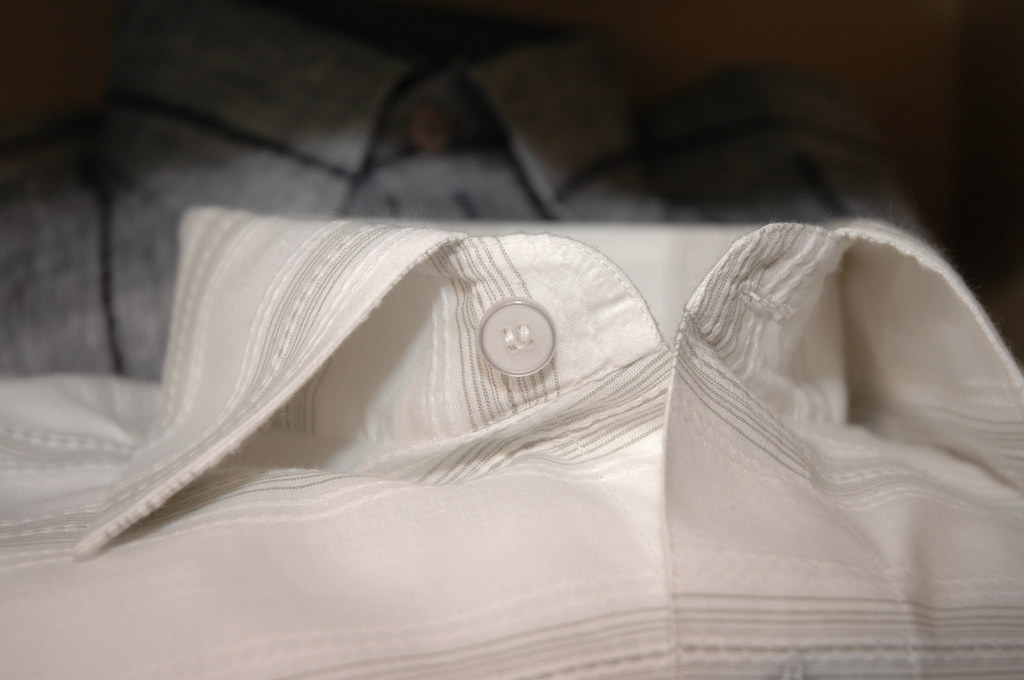
In brief:
- The mandarin collar (or band collar) is a straight collar 2 to 3 cm high, without points or a fold, whose name comes from the tunics worn by Chinese officials under the Qing dynasty.
- It particularly suits slim, long necks, and visually structures round faces.
- It is not worn with a classic tie, unlike the spread or point collar.
- The mandarin collar has gained ground in less formal dress codes since the mid 2010s.
Origin and definition of the mandarin collar
The mandarin collar, also called a band collar or, in some regions, a Nehru collar, is a low, straight collar that wraps the neck without folding outward. Its name comes from its association with the tunics worn by high-ranking Chinese officials under the Qing dynasty (1644-1912), later popularized in the West during the 20th century as the “Mao collar” in reference to Mao Zedong, who wore this type of garment.
It should not be confused with the Nehru collar, more associated with India and the wardrobe of Jawaharlal Nehru, even though both terms today refer to a very similar collar in Western fashion.
A simple but precise technical construction
The mandarin collar consists of a single strip of fabric, usually lined and fused to hold its shape, attached directly to the neckline. Its height ranges between 2 and 3 cm, compared to 4 to 5 cm for a classic collar with points. It closes with a single button or a small hook, with no fold to slide a tie under.
Mandarin collar vs classic collar: the practical differences
The classic collar (spread collar, point collar, button-down collar) has two points that fold down on the sides, leaving space to knot a tie. The mandarin collar has neither points nor a fold.
What this changes visually
- Neck silhouette: the mandarin collar visually lengthens the neck by creating a continuous vertical line, while the classic collar widens the shoulder line with its points
- Formality: the classic collar remains the reference for a very formal context (suit and tie), while the mandarin collar sits in a more contemporary, smart-casual register
- Wearing a tie: impossible with a standard mandarin collar, either standard or optional with a classic collar
Shirt collar comparison table
| Collar type | Height | Tie worn | Register |
|---|---|---|---|
| Mandarin / band collar | 2 to 3 cm | No | Contemporary, smart-casual |
| Spread collar | 4 to 5 cm, wide points | Yes | Classic, formal |
| Point collar | 4 to 5 cm, close points | Yes | Classic, elegant |
| Button-down collar | 4 cm, buttoned points | Optional | Casual, American |
Which body type suits a mandarin collar
Choosing a collar depends directly on neck and face shape.
Slim or long neck
The mandarin collar highlights a slim or long neck by creating a continuous, streamlined line, without the visual break created by a classic collar’s points. It is one of the most flattering collars for this body type.
Round face
A straight, vertical collar like the mandarin collar adds structure that balances the curved lines of a round face, an effect commonly used in styling to visually elongate features.
Short or wide neck
Conversely, a short or wide neck is generally better served by a classic collar with wide points, which opens up the base of the neck rather than emphasizing it.
When to wear a mandarin collar
Suitable occasions
- Smart-casual outfits: paired with chinos or a suit worn without a tie, the mandarin collar works particularly well for informal evenings
- Creative professional environments: fashion, design, tech and communications industries increasingly include this collar in their dress code
- Summer and hot climates: with no tie or points trapping heat at the neck, the mandarin collar is often favored in warm weather, especially paired with breathable fabrics like linen (see our article on choosing between linen and cotton)
Occasions to avoid
A very formal context requiring a suit and tie (traditional wedding, official ceremony, some banking or legal environments) remains the domain of the classic collar. For this type of occasion, our guide on what shirt to wear for a men’s wedding covers the most suitable options.
What market trends show
“The band collar has seen renewed interest since the mid 2010s, driven by demand for a more relaxed yet still structured men’s wardrobe.” Source: Menswear industry observation, 2015-2024 trends
This trend is visible in particular in the collections of shirt makers who now systematically include a mandarin collar line alongside their classic collars, such as the mandarin collar shirts collection.
How to care for a mandarin collar shirt
The mandarin collar, structurally simpler than a pointed collar, requires particular attention at the base fold to avoid it breaking when ironed. Our cotton shirt care guide covers the right iron temperature for each fabric and the habits that keep the collar’s shape over time.
Frequently asked questions
What is a mandarin collar and who suits it?
The mandarin collar, or band collar, is a straight collar without points or a fold, 2 to 3 cm high, that wraps the neck without turning down. It particularly suits slim, long necks, which it highlights, and round faces, which it visually structures. Unlike a classic collar, it is not worn with a traditionally knotted tie, which makes it a more contemporary, streamlined choice.
Can you wear a tie with a mandarin collar?
No, a mandarin collar does not allow a classic tie knot because it has no fold to slide it under. Some very wide variants tolerate a thin knot, but the most common use remains without a tie, buttoned to the top or slightly open.
Does a mandarin collar work in a professional setting?
Yes, in industries that accept a less formal dress code (creative, tech, fashion), the mandarin collar is increasingly common. In a very formal context requiring a tie, it remains best avoided.
What is the difference between a mandarin collar and a Nehru collar?
Both terms today refer to a very similar collar in Western fashion: a straight collar without points. The mandarin collar refers to official Chinese tunics, the Nehru collar to the Indian wardrobe popularized by Jawaharlal Nehru. In everyday use, the two terms are often used interchangeably.
Should a mandarin collar be worn buttoned or open?
Both uses exist. Buttoned to the top, it gives a more structured, formal look. Slightly open, with the top button left undone, it sits in a more relaxed register, particularly for evenings or weekends.